Personal Scent Pro Forma
Personal Scent
Three-Year Pro-Forma Financial Analysis
Prepared by: Hebbard | EBD 481 — Entrepreneurial Finance | Spring 2026
1. EXECUTIVE OVERVIEW
Personal Scent is a specialty retail startup located in historic downtown Wilmington, NC, founded by Stephanie Drummond. Customers visit the shop to create their own custom perfume from a curated library of essential oils, guided by proprietary palette-matching software developed from Stephanie's professional R&D background. The concept targets Wilmington's tourists, local women, and experience-seeking consumers who value natural ingredients and personalization. The following write-up documents all key assumptions, expense sources, and answers the specific questions posed in the case. All projections were built using case facts, local market research, and reasonable entrepreneurial judgment.
2. REVENUE ASSUMPTIONS & SEASONALITY
Pricing and Capacity
The shop operates six days per week, ten hours per day, with five one-hour workstations — a peak capacity of 60 customers per day or 360 per week. Based on Stephanie's focus-group research, Year 1 targets 120 customers per week, roughly 33% of physical capacity, which is a conservative opening assumption for a new retail concept. Each customer pays a flat $85.00 per session. This price is set at approximately three times the cost of essential oils and bottles, making COGS a consistent 33.3% of revenue. At the 120-customer weekly rate, a full month generates approximately $40,800 in revenue (120 × $85 × 4 weeks).
Monthly Seasonality — Year 1
Revenue is not uniform throughout the year. Wilmington's economy peaks in summer and softens in winter. The following indices are applied to the $40,800 monthly baseline:

Winter months (Jan–Feb) are set at 80% to reflect reduced tourism. Summer (Jun–Aug) peaks at 110% capturing Wilmington's beach season surge. Shoulder months hold at 95–105%. This produces Year 1 annual revenue of $481,440. A 20% annual growth rate is applied in Years 2 and 3, driven by increasing brand awareness, social media marketing, and word-of-mouth referrals. Year 2 revenue grows to $577,728 and Year 3 to $693,274.
3. EXPENSE ASSUMPTIONS & SOURCES
Cost of Goods Sold
COGS is modeled at 33.3% of revenue each month, directly reflecting Stephanie's three-times-cost pricing strategy. This variable structure means COGS scales automatically with revenue: Year 1 $160,480; Year 2 $192,576; Year 3 $231,091. The initial $60,000 inventory investment is treated as a lump-sum cash outflow in Month 1 of Year 1 on the cash flow statement.
Payroll
Year 1 employs two workers in addition to Stephanie, each paid $11/hour for 60 hours per week (6 days × 10 hours), yielding $5,280/month in wages. A third employee is added in Years 2 and 3 at the same rate ($7,920/month) to support the 20% growth in customer volume. Owner compensation starts at $1,000/month in January–February of Year 1 to preserve cash, rises to $2,000 for the remainder of Year 1 ($22,000 annual), then $3,000/month in Year 2 and $4,000/month in Year 3 as cash flow strengthens. The employer share of FICA — Social Security and Medicare at 7.65% — is applied to all wages and owner pay each month: approximately $480–$557/month in Year 1, rising to $835/month in Years 2 and 3. Source: IRS Publication 15, 2025.
Fixed & Semi-Fixed Operating Expenses
Rent is $5,000/month ($60,000/year) for the 1,000 sq. ft. downtown space at $5.00/sq ft, consistent with Wilmington downtown retail comps (LoopNet, 2025). Utilities run $350/month for electricity, water, and internet. Equipment service contracts total $850/month, including the $200/month software service fee and $600/month for computers, registers, and other hardware. General liability insurance is $250/month in Year 1, rising to $275 in Years 2–3 (Source: NEXT Insurance/Hiscox NC retail quotes, 2025). Advertising is $1,300/month in Year 1, $1,500 in Year 2, and $1,700 in Year 3, focused on social media and local Wilmington outlets — the primary driver of the assumed 20% annual revenue growth.
Variable & Other Expenses
Credit card processing fees are calculated at 3% of monthly revenue, one of the larger variable costs in the model: $14,443 in Year 1, $17,332 in Year 2, and $20,798 in Year 3. Source: Square and Stripe fee schedules, 2025. Depreciation is $2,250/month ($27,000/year) on $135,000 of capital equipment and workstations straight-lined over 60 months — a non-cash charge on the income statement excluded from cash disbursements. Loan interest is $1,667/month on the $200,000 loan at 10% simple interest. Additional expenses include repairs and maintenance ($150/month), office supplies ($100/month), professional fees for LLC registration and tax preparation ($150/month), and cleaning and janitorial ($250/month). These line items reflect standard operating costs for any downtown retail startup and were identified beyond what the case explicitly listed.
4. CAPITAL STRUCTURE & FATHER'S INVESTMENT
Total startup capital required is $215,000, covering five workstations ($100,000), equipment ($35,000), software development ($20,000), and initial inventory ($60,000). This is funded by a $200,000 five-year bank loan at 10% simple interest ($3,333/month principal plus $1,667/month interest = $5,000/month total debt service) and $15,000 of Stephanie's personal savings. The business is organized as an LLC, providing liability protection and pass-through taxation — no corporate income tax is applied to the pro-forma.
Based on this pro-forma, Stephanie's father does not need to make a required equity investment in the base-case scenario. The bank loan and personal savings fully fund all startup costs, with a small opening cash buffer remaining after Month 1. However, that buffer is thin. A prudent recommendation is for her father to hold $15,000–$25,000 as a contingency reserve he can deploy if early cash flow comes in below forecast. This is not a required investment but a safety net against minor cost overruns or slower-than-expected opening traffic.
5. THREE-YEAR FINANCIAL SUMMARY
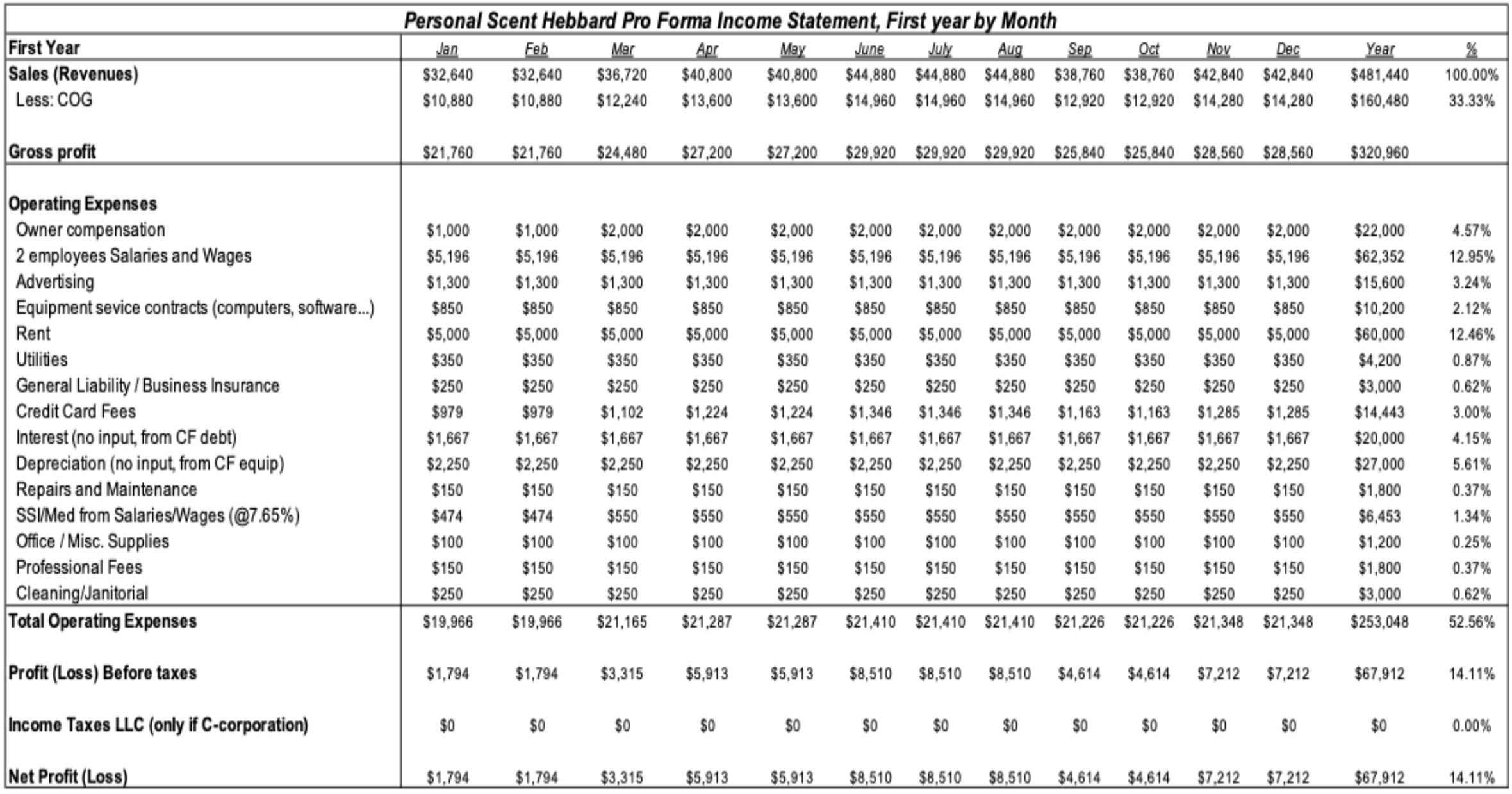
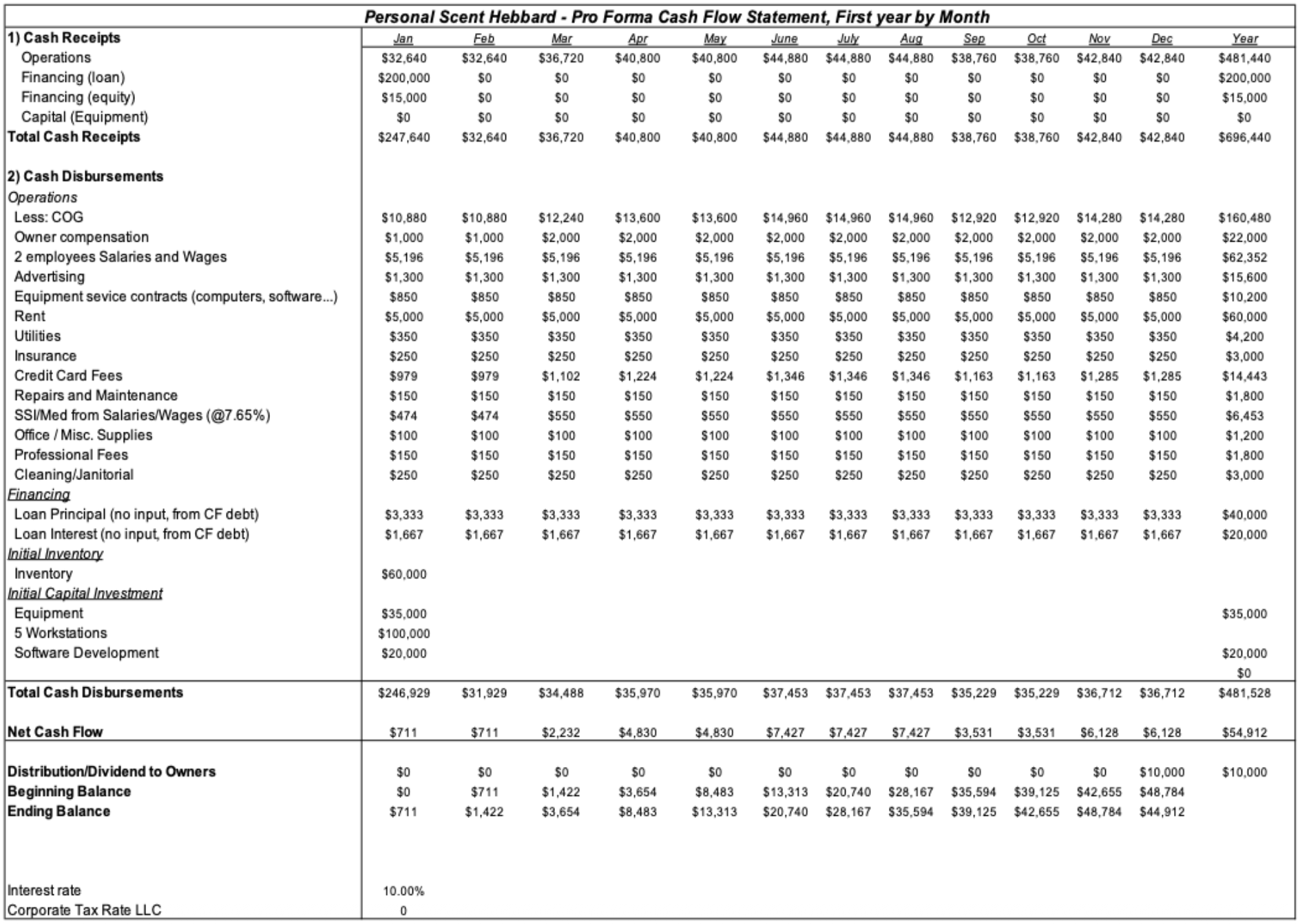
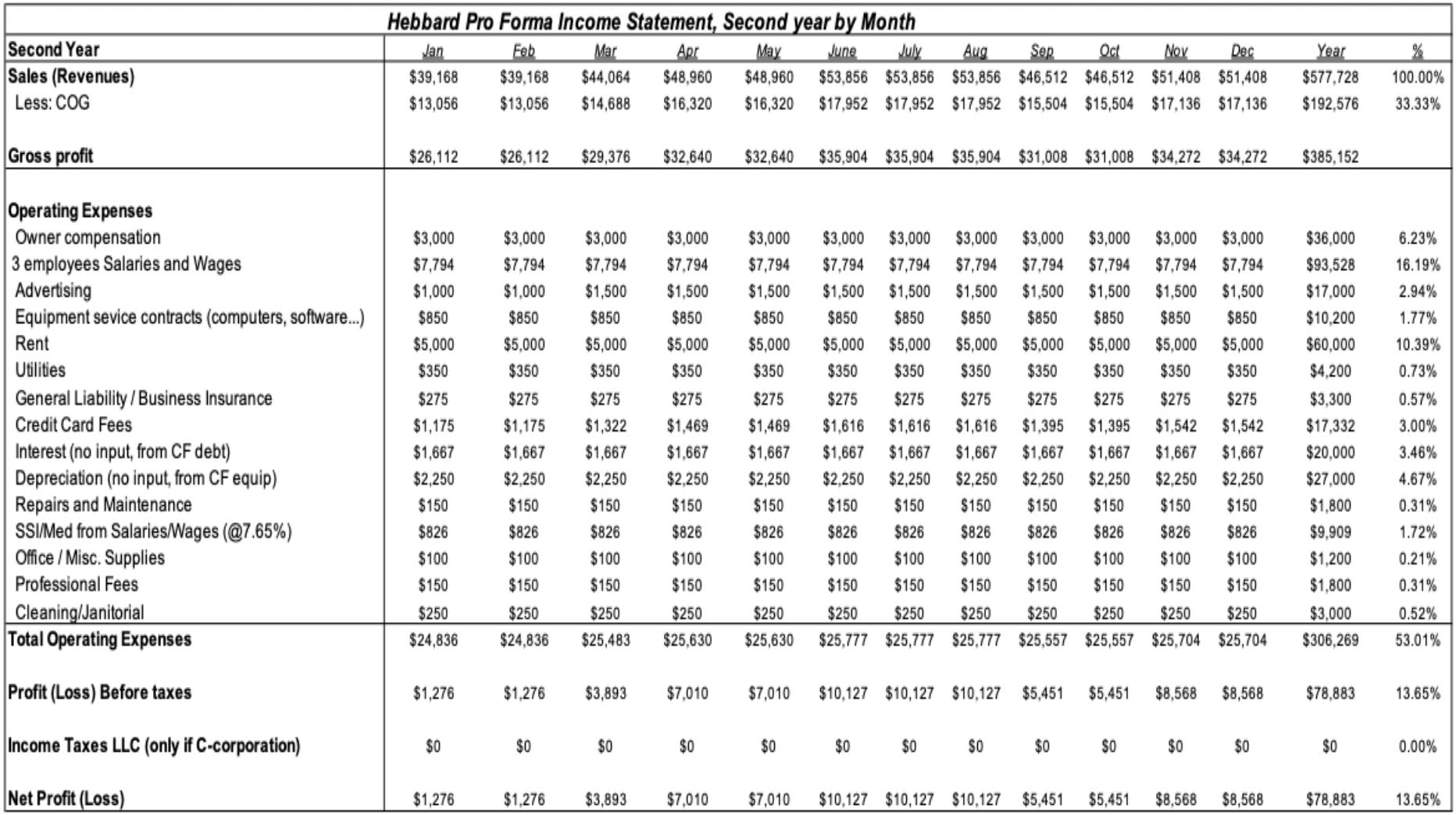
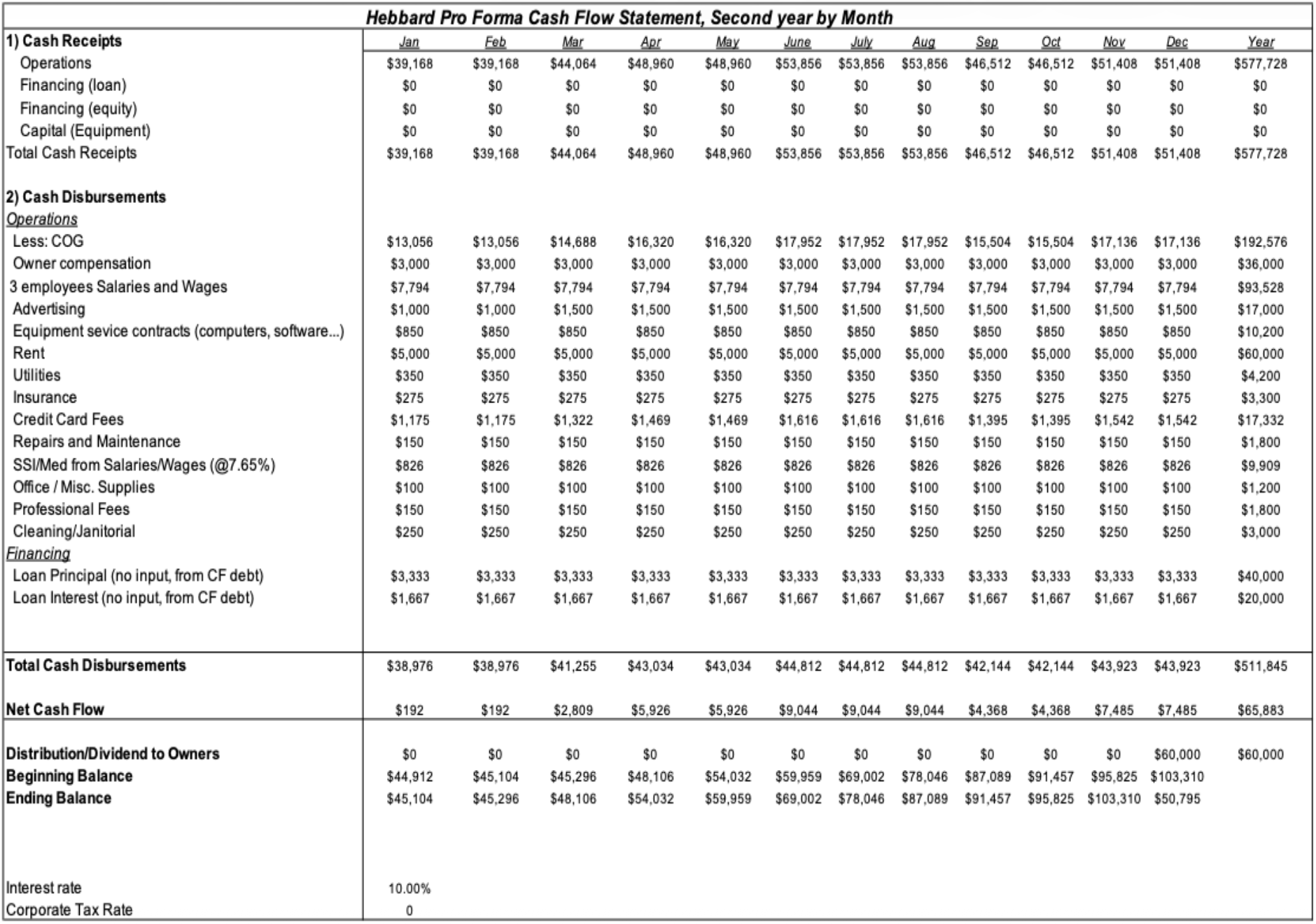
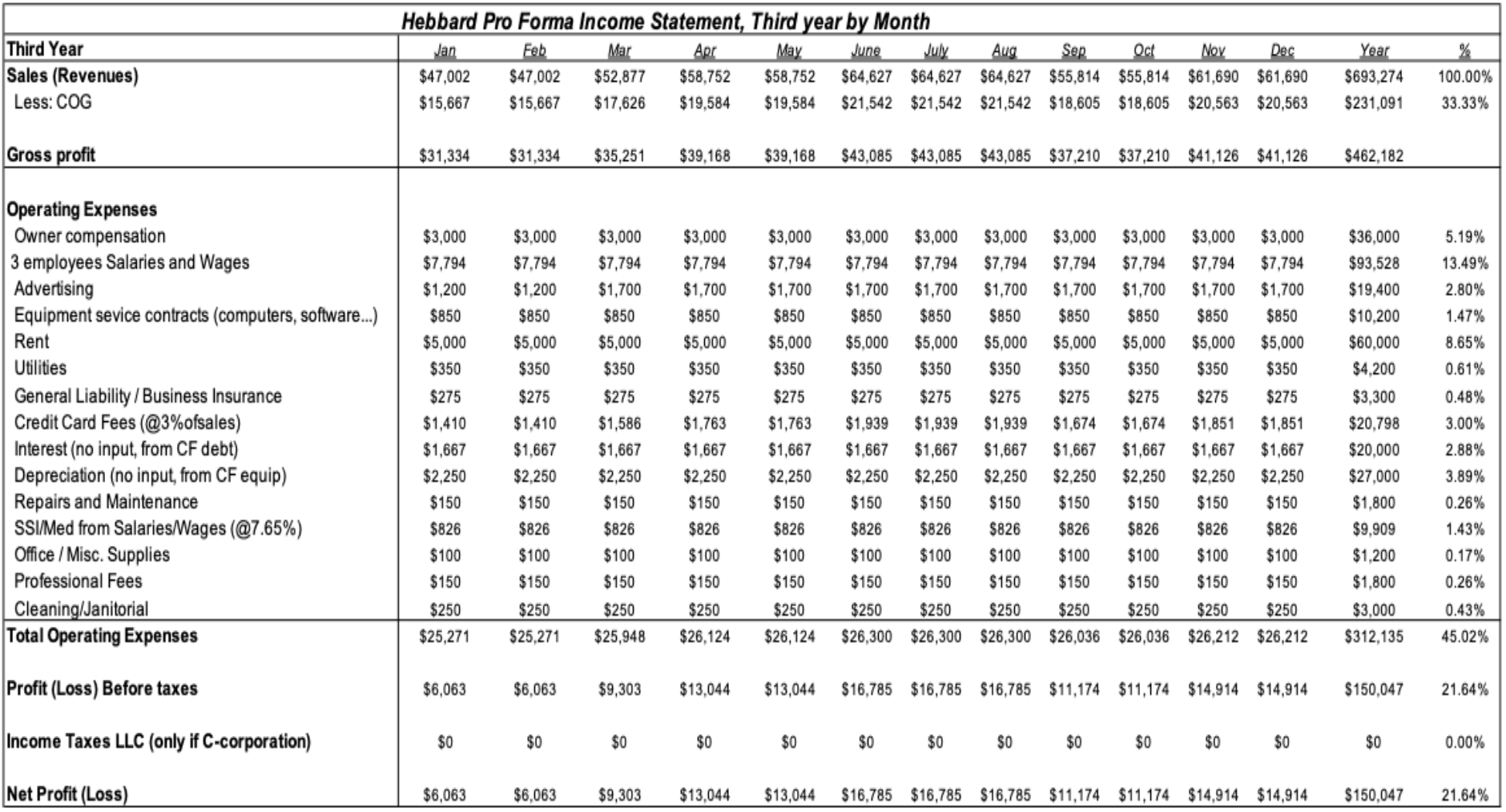
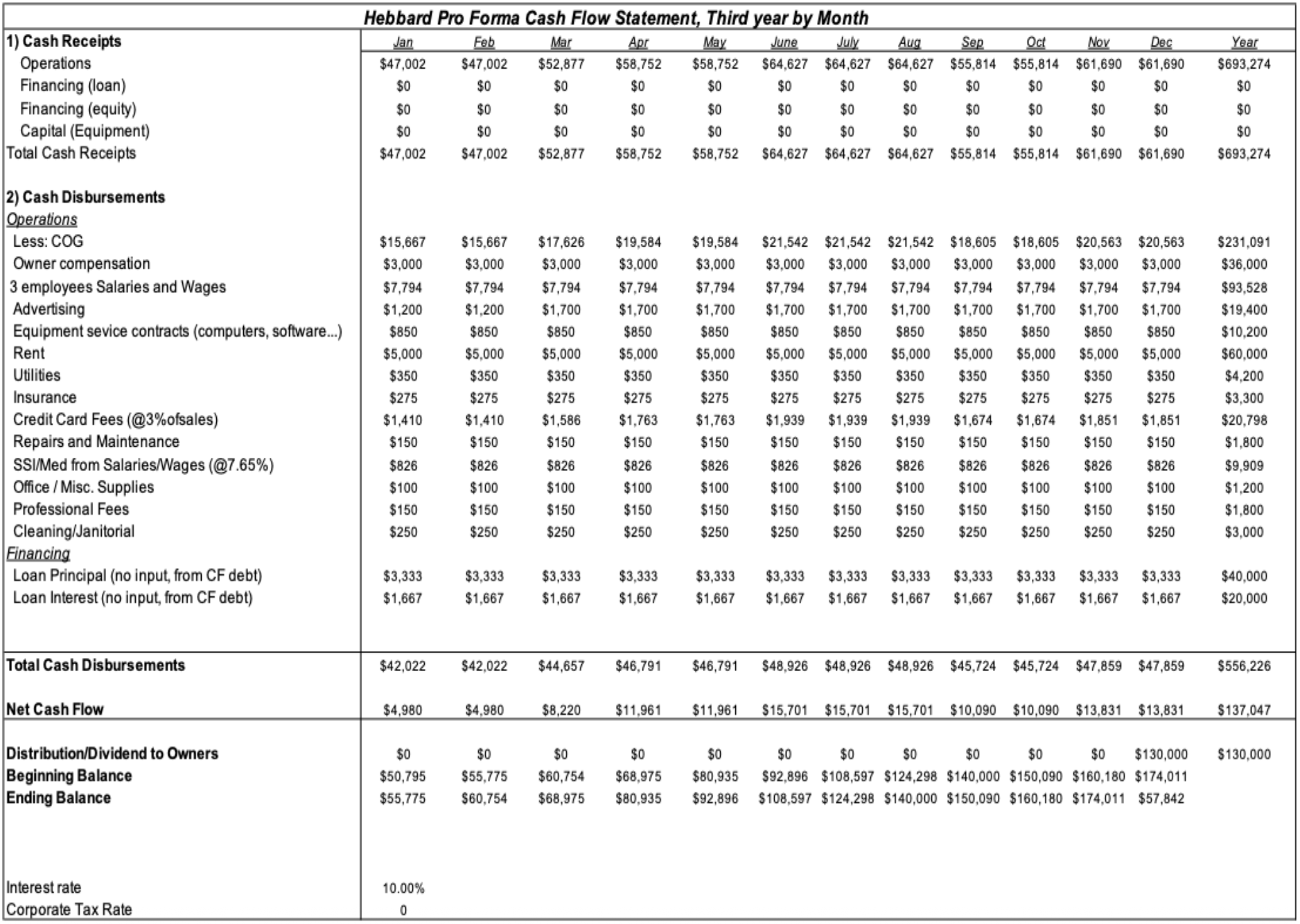
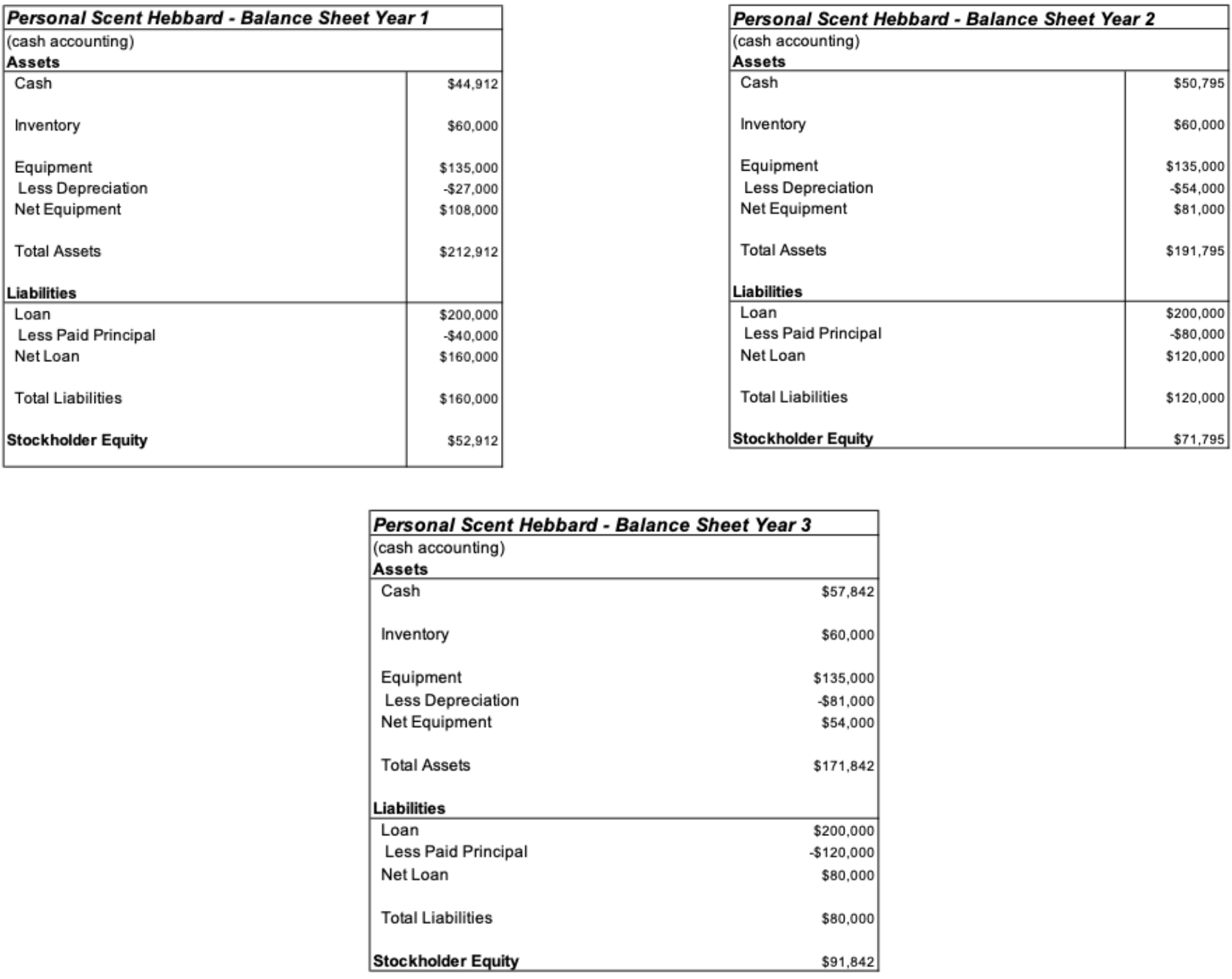
Personal Scent is profitable in all three years, generating net income of $66,827, $76,256, and $147,420 respectively. Net margin strengthens significantly in Year 3 (21.3%) as revenue scales faster than fixed costs. Stephanie distributes dividends to herself as owner each year — $10,000 in Year 1, $60,000 in Year 2, and $130,000 in Year 3 — while maintaining healthy cash reserves. Ending cash grows steadily from $45,627 to $56,902 over the three years. Stockholders' equity increases each year as the business builds retained value, rising from $53,627 to $90,902 by end of Year 3 despite the significant distributions.
6. BREAK-EVEN ANALYSIS
The case asks: if the business is not profitable by end of Year 2, how many weekly customers are needed to break even? As shown above, Personal Scent is profitable in all three years, so break-even is a downside reference point rather than a concern.
In Year 2, average fixed and semi-fixed monthly costs (excluding variable COGS and credit card fees) total approximately $25,472. Each customer contributes a net margin of $85.00 revenue minus $28.33 COGS (33%) minus $2.55 credit card fee (3%) = $54.12 per customer. Monthly break-even = $25,472 ÷ $54.12 ≈ 471 customers per month, or roughly 109 customers per week. Stephanie's Year 2 forecast is 144 customers per week — a 32% cushion above break-even. Weekly traffic would need to fall from 144 to 109 before the business stops making money, providing a reasonable margin of safety.
7. RISKS & CONCLUSION
Personal Scent is a financially sound concept. Revenue assumptions are grounded in conservative capacity utilization, local market data, and focus-group research. The cost structure accounts for all major retail startup expenses. Primary risks include lower-than-expected Year 1 foot traffic if social media traction builds slowly, input cost volatility for essential oils, and potential competition from other experiential retail concepts entering the downtown Wilmington market. On the upside, the $85 average ticket could run higher if customers choose premium oil combinations, and Wilmington's continued tourism growth supports the seasonal uplift assumptions.
Overall, the three-year pro-forma strongly supports moving forward with Personal Scent. The business is profitable from Year 1, generates growing cash flows, distributes increasing owner dividends, and steadily builds equity — all indicators of a viable and sustainable small business opportunity in the Wilmington market.
REFERENCES
IRS Publication 15 (Circular E), Employer's Tax Guide, 2025. irs.gov.
LoopNet Commercial Real Estate — Wilmington, NC Downtown Retail Listings, 2025.
NEXT Insurance & Hiscox — Small Business General Liability Quotes, NC Retail, 2025.
Square & Stripe — Credit Card Processing Fee Schedules, 2025. squareup.com; stripe.com.
NC Secretary of State — LLC Registration & Annual Report Requirements, 2025. sosnc.gov.
Galbraith, C.S. (2026). Personal Scent – Spring 2026. Cameron School of Business, UNCW.